The first build
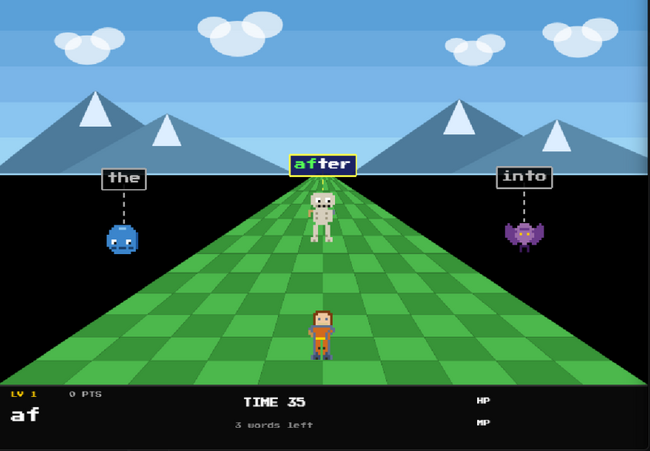
Once the idea was bugging me enough, I sat down and threw together a prototype. I didn’t want to spend a week setting up a proper project just to find out the whole idea was a dud. So I took whatever shortcuts I could get away with: one file, no proper structure, just enough to see the thing move.
I threw together quick placeholder art for three enemies. Slime, skeleton, bat. Nothing fancy. Just rough stand-ins so I could see what was happening on screen. A blue blob for the slime, a bony thing for the skeleton, a purple bat. They weren’t good sprites, but they were enough for the build. I’d come back to the art later if the game was worth finishing.
Under the enemies I put a hero sprite with a little sword. Above each enemy I put a word, like a nameplate. At the bottom of the screen was a strip showing the letters I’d typed so far. That was the whole interface.
The word pool was about thirty words. Fire, ice, hit, slash, blade, flame, thunder. I loosely grouped them into easy, medium, and hard, but there wasn’t much rigor to it. Whatever sounded like a fantasy word went in.
It came together fast. I didn’t even commit it anywhere for a few days.
#The first problem
I wasn’t handing this off to anyone yet. I was just playing it myself, round after round, seeing what felt wrong. There was no structured testing. I winged it. Play, notice something dumb, go fix it, play again.
The main thing I noticed was that I wasn’t making real decisions during a round. Three enemies, three words, I’d just start typing whichever one my eyes landed on first. It didn’t matter which. They were all the same to me. Same threat, same health, same speed. They were three bags of letters lined up at the top of the screen, and the game was just “clear the letters.” Fine for a prototype. Not interesting.
What fixed it was giving the enemies stats and, more importantly, an ATB gauge under each one. The ATB gauge is the bar that fills up over time until the enemy attacks you. Different enemies got different fill speeds. A bat might be two seconds from swinging at you while the slime still had twenty seconds before its bar filled. Suddenly I had a real reason to kill the bat first, even if its word was shorter and easier. The slime was fine for now. The bat wasn’t.
That single change turned the game from “type the letters” into “read the threats and pick what to hit.” I’d look at the screen, see which ATB gauge was closest to full, decide whether I had time to finish the word I was mid-way through, sometimes abandon a word mid-letter because the priorities shifted. Three enemies on screen is just a list until their gauges tell you which one matters.
#The part that already worked
The part that stuck from the first playthrough was the moment a word finishes. The last keystroke lands, the enemy flashes white, the word clears off the screen. That sequence is the part of the game I care about most. Every mode I’ve built since, I check whether that moment still feels right in it. If it doesn’t, the mode’s wrong.
#What survived
Almost nothing visual. The placeholder sprites from the first version are long gone, replaced with real art. The background was a flat gradient sky with triangle mountains and a goofy checkerboard floor; that got swapped out for proper scenes. The hero sprite got redone, then redone again.
What survived is the skeleton. Three enemies per regular round, positioned the way they were that first afternoon, with words hanging above them like nameplates and ATB gauges ticking underneath. The flash when a word finishes is still the flash. The triage of scanning gauges and picking which enemy to hit next is still the actual game.
That’s more than I expected. When I threw the first version together I figured maybe 10% of it would last. Most of the skeleton did.