Adventure mode, and why it ended up at ten minutes
When I was a kid I read a lot of Choose Your Own Adventure books. The orange-spined ones. The ones where you’d read a few pages, hit a numbered choice, flip ahead, and find out whether you’d just stepped into a trap or talked your way past a guard. I read them out of order, kept fingers wedged into earlier pages so I could back up if a path went bad, and treated the whole thing like a puzzle as much as a story. The reading itself was different from a regular book. You were leaning in. You were checking the prose for clues, because the next decision usually depended on how carefully you’d read the last paragraph.
Later, in my teens, I spent a lot of time in MUDs. Text-only multiplayer dungeons. You’d connect over telnet, type commands, and the game would describe a room to you in second person. You stand at the edge of a forest clearing. A narrow path winds north between the trees. A weathered signpost leans against a stump. Then you’d type north, and you’d get a new room. Then look signpost and you’d get whatever the builder had written about it. The whole world was prose. The whole world was you reading it and typing your way through it.
The perspective stuck. Choose Your Own Adventure books were second person. MUDs were second person. The room descriptions in MUDs especially, the way the writer would put you in a place, describe what you noticed first, then what you noticed when you looked closer. Reading a good MUD room felt like being told a small story about yourself, because you were the character. That little trick, you see, you hear, you smell, did a lot of work for very little cost.
I mentioned in the origin post that MUDs are the reason I learned to type. What I didn’t say there was that the descriptions did most of the teaching, not the commands. Commands are short and repetitive, you learn north and look and get and you’re done. The descriptions are where the prose actually lives, and where the time actually goes. You linger inside a room description because you’re scanning it for the object you can pick up, the door you can open, the npc you can talk to. The reading is engaged. You’re paying attention to every noun in the paragraph because any one of them might be the thing the room wants you to notice.
Typing programs never got me to read that attentively. They give you a block of text to copy and the text is just fuel for the exercise. You don’t care what it says. You care about your error count. The MUD got my attention because the prose was load-bearing, and as a side effect, I typed a lot of words.
#The story-mode gap
Classic mode in Keeb Quest is the focal mode. That hasn’t changed. Three monsters, each one carrying a word, and the run lives or dies on how fast and how clean you can clear them. But there was a kind of typing I wasn’t getting to do anywhere in the game, and it was the kind I most associated with how I actually learned to type as a kid. There was no place in the game where you’d sit with a paragraph, read it, and type it because you wanted to know what came next.
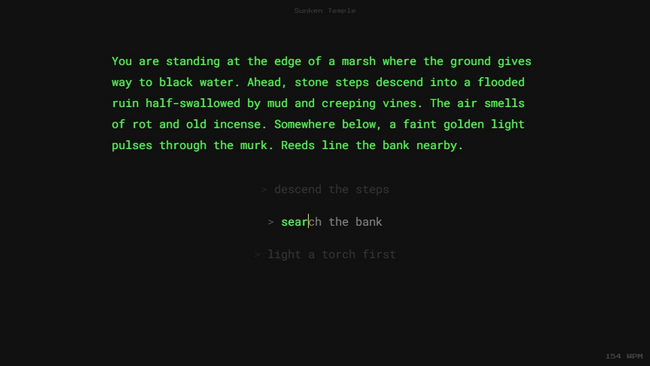
Adventure mode is the part of Keeb Quest that’s for that. You pick a story. You read a passage. You type the passage. Then you get a choice, two or three options, and each one is also something you have to type. Whichever one you finish first is the path you take. The next passage continues from there. Stories branch and converge, and they end in different places depending on what you typed.
The choice typing is the part I was most pleased with once it was working. It turns the choice into a small typing race against yourself. You can read all the options first if you want, or you can just commit to one and start typing. Either way, the act of choosing is the act of typing, and that means the game is still a typing game even during the parts that would normally be a menu.
#Typing changes the read
Reading a passage and typing a passage are different things. When you read a passage, your eye skips. You catch the gist, you move on. You miss adjectives, you miss subordinate clauses, you miss the careful little setup the writer planted three sentences ago that’s going to matter in the choice you’re about to make.
When you type a passage, your eye doesn’t skip. Your fingers won’t let it. You go letter by letter, word by word, and the writing lands on you in a way that reading at normal speed doesn’t. You spend extra time on the descriptions because you have no choice, that’s just how long it takes to type them. You notice the adjectives because you typed them. You notice the names because you had to spell them.
What surprised me, playtesting the stories, was how much more I liked the prose when I was typing it. Passages I’d already read through a dozen times suddenly felt different the first time I had to type them. Phrases I’d half-paid-attention-to became phrases I knew. You read what you type in a way you don’t read what you skim.
This is the closest a typing game can get to the MUD feeling without actually being a MUD. The room is in front of you. You’re typing your way through it. You can’t move on until you’ve engaged with what’s there. And because the choice is also typed, the engagement carries straight through into the decision.
#Why ten minutes
Stories in adventure mode are tuned to take about ten minutes to play through, the same target a classic-mode run lands on. That wasn’t an accident.
I tried longer first. Some of the early stories were closer to twenty or twenty-five minutes if you played them through to an ending. They read fine as stories but they didn’t sit right inside the rest of the game. You’d start one and feel like you were committing to a session, not a run. The whole reason the rest of Keeb Quest sits at ten minutes is because that’s the size of thing you can do at lunch, between meetings, while waiting for something to compile. A twenty-minute story is a different commitment. It’s an evening thing.
The other reason ten minutes won was daily practice. If a story takes ten minutes, you can play one in the morning before work and that’s your typing practice for the day. That reframing turned out to matter a lot. People who use typing tests for daily practice already have a slot in their day for it. A ten-minute story slots into the same slot. A twenty-five minute story doesn’t, it has to fight for time against other things, and it usually loses.
So I cut the longer stories down. Tightened the prose. Trimmed branches that weren’t pulling weight. Let some choices skip you forward instead of unfolding into another full passage. The result is a set of stories you can actually finish before your coffee gets cold, and that you can come back to tomorrow and play a different branch of, and the day after that play a third.
#Where it lands
Classic mode is still the focal mode. Adventure is practice for it, in the same way Academy is practice for it. But adventure practices engagement more than speed. It’s the slow, careful, all-the-way-through-the-sentence kind of typing that happens when you actually want to know what the sentence says. That kind of typing is what made me fast in the first place, and it’s the kind I most wanted to hand back to whoever’s playing.
If the game does its job, you finish a story, you’ve practiced your typing for the day, and you’ve also read something. I care most about that second part. A typing test gives you back numbers. A story gives you back a small thing you read. I’d rather hand the player both.