Designing for flow
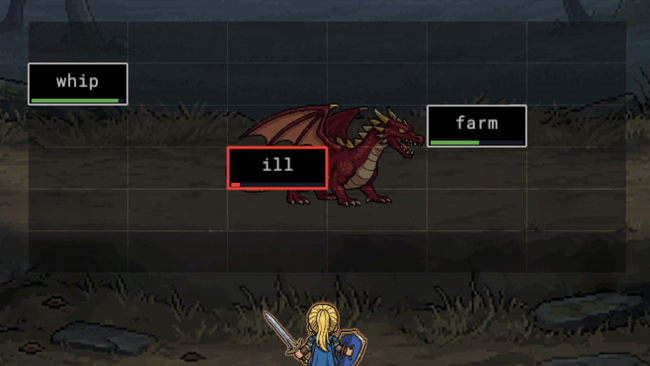
The thing I wanted most from this game was the feeling of not stopping. You sit down, your fingers find the home row, and you type. The moment you lift your hands off the keyboard to wait for something or pick something, you’re out.
Typing makes flow state achievable because the feedback loop is so tight: you think a letter, you press it, you see it appear. The whole design of Keeb Quest is built around not breaking that loop.
#Always a word on screen
There is always at least one word visible and ready to type. When you finish an enemy’s current word, the next one is already sitting underneath it.
This rules out a lot of things. Enemies that hide their words until you target them. Words that appear with a delay. Animations that cover the text area. Enemy types that obscure their word, swap it mid-type, or require you to read a clue before you can figure out what to type. All of them introduced a pause, and every pause was a crack in the flow.
Reading ahead matters too. Your eyes are always a word or two past where your fingers are, preloading what’s coming next. That preload is what separates halting, word-at-a-time typing from the smooth continuous kind. So there is always at least one word of read-ahead visible, and nothing interferes with it.
#Decisions happen while typing
In battle, targeting is implicit. You start typing, and whichever enemy’s word matches is the one you’re attacking. No target cursor, no selection step. The decision and the action are the same keystroke.
One small thing that I feel has a big impact: the word lists try to give each enemy a word that starts with a different letter. It’s not always possible, but when it works, you don’t even have to think about which enemy you’re targeting. You see the word, you press the first letter, and it’s already resolved.
#Difficulty without interruption
The enemies that work are the ones that change the challenge without interrupting it. Enemies with long words. Enemies with short words that refill fast. Enemies with high defense that barely flinch when you hit them. All of those make the game harder. None of them make you stop typing.
#Words you actually type
If a word shows up that you don’t recognize, you slow down. Not because it’s long, but because your brain switches from typing to reading. You stare at it, sound it out, start pecking letter by letter. That stare is a flow break caused by the content, not the mechanics.
So the word list is curated for common, everyday vocabulary. It leaves out obscure medical terms, scientific Latin and crossword-puzzle words. If a word made me hesitate during testing, it came out. Common words, typed fast and clean, is the skill that actually transfers to the typing you do the rest of the day.
#The cost
Designing around unbroken flow means giving up complex strategic decisions, elaborate enemy patterns, anything that requires you to stop and think instead of type. What you get in exchange is a game where you sit down and ten minutes pass and you don’t know where they went. That’s the trade I wanted to make.